
Displacement: a rare viewpoint
Thoughts from Nathalie Wilson, further to the Women's Perspective Live on Displaced Women.

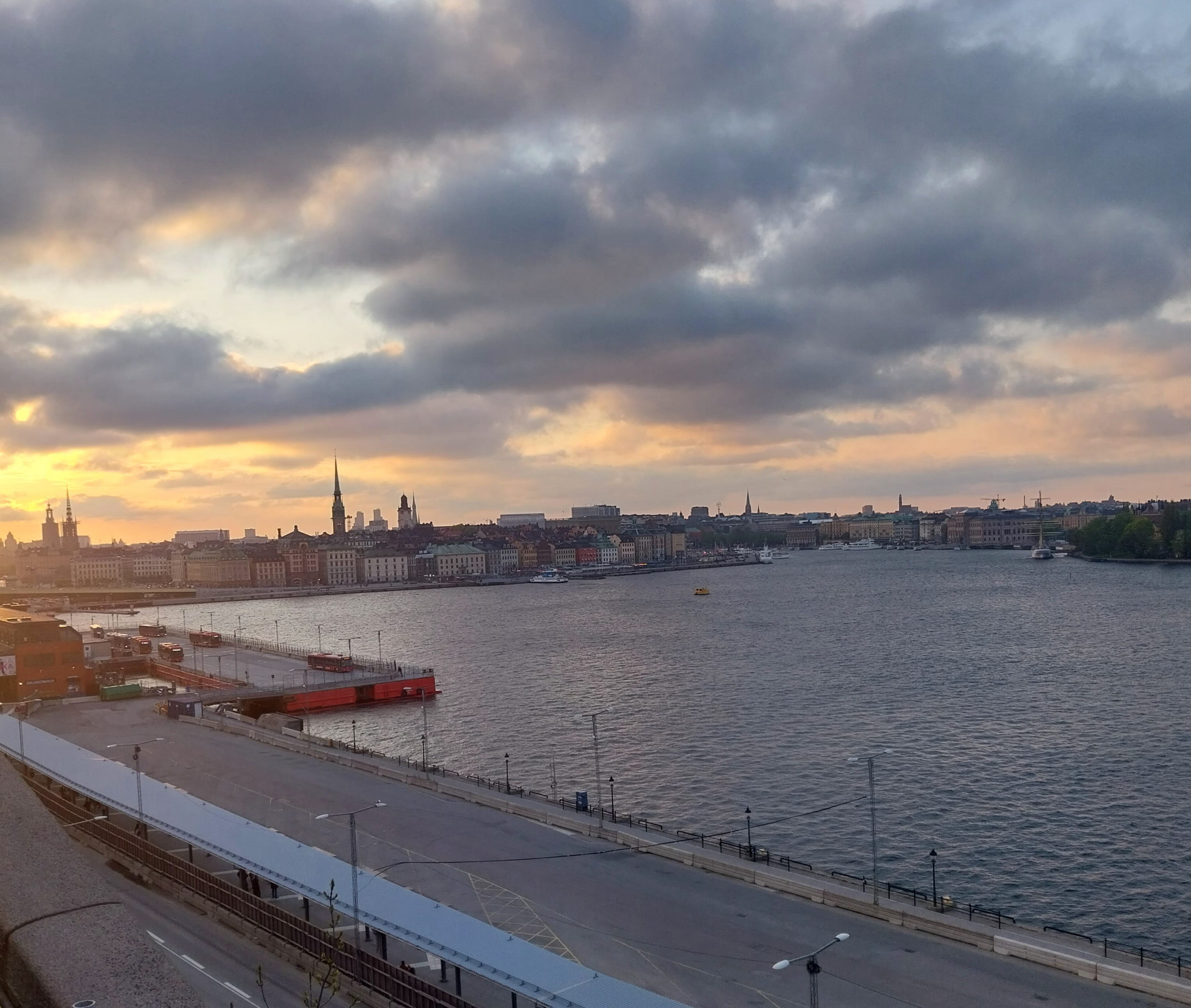
Stockholm. Picture taken during my visit to see Nathalie last May.
I was adamant I needed the voice of one of my oldest friends (also a fellow linguist), Nathalie Wilson, as I looked at the matter of women displaced, all around the world, geographically, culturally, politically, socio-economically, and more, for my Live talk last weekend.
A native of North Yorkshire (UK), Nathalie grew up mostly in West Africa, then attended boarding school back in England. She and I met in Autumn 2007 in Yaroslavl, Russia, when we were both studying there. Further to our studies we both ended up working as freelance translators/interpreters, sometimes working together on an improbably weird range of projects, when we were both based in London.
A few years ago, Nathalie relocated with her family to Sweden. She her husband and their sons are (I would say) the ultimate model new Swedes, both working in Swedish and their children having been raised bilingual from the very beginning of their lives.
Nathalie’s husband is partly Dutch, and Nathalie passed her Dutch citizenship exams a couple of months ago.
What it means to be a woman displaced in the world is something that has come up organically over and over in our lengthy and (magically) chaotic conversations over the years.
When I received Nathalie’s answers to my questions on the subject, about what displacement meant to her, I thought her answers deserved their own follow up post with Women’s Perspective.
Here are her thoughts:
To answer your first question… I think I first became aware of displacement as a child without being fully aware of what it actually meant or it as a phenomenon….in the early ‘90s as a result of the Rwandan genocide the media covered the refugee crisis provoked by the fighting there that caused millions of Hutus to flee to neighbouring countries following the Tutsi-led Rwandan Patriotic Front taking control of the country. I can remember the images and reporting of this crisis and the mass displacement it provoked in the international media – viewed on my parents TV set in their bedroom on CNN news.
***
My mother and father were living in Nigeria during the mass expulsions of African migrants from neighbouring countries under the rule of President Shagari in 1983. At the time the president issued an executive order requiring all undocumented immigrants to leave the country within 14 days, with more than one million of these migrants being Ghanaians. My parents’ cook in Lagos at the time, Jacob, was one such migrant. My mother would recount to me how my father drove Jacob to a small vessel that was leaving for Ghana - they gave him food and a clock and some money, thinking this would be the last time they saw him. A decade or so later, my parents having had me and my brother and now living in Accra, Ghana, Jacob appeared at the gate of our house. At first when told there was a visitor by the name of Jacob who was there to see her, my mother didn’t recall she knew a ‘Jacob’, not thinking for a moment that it would be him after all those years. It was.
***
Meanwhile since 2023, along much of the waterfront in Lagos, Nigeria, there have been ongoing forced evictions of people living in what are termed ‘informal settlements’, makeshift housing and homes in areas such as Makoko, the largest of such informal settlements built on stilts in the water, where 40,000 people alone have lost their homes. These demolitions and evictions, condemned by UN experts as constituting domicide and crimes against humanity, have destroyed communities all under the governmental guise of ‘development’, yet all the while people are simply further deprived of access to basic services and infrastructure. Often local thugs or ‘area boys’ are contracted by the authorities to go around violently enforcing such evictions, while those who have tried to protest have ended up being tear-gassed and had their homes torched by police. (PS there is a really interesting NPR programme about it all here: https://www.npr.org/transcripts/nx-s1-5821608)
***
More recently, my encounters with displacement have been closer to ‘home’ in the UK. In 2013, on the road on which my husband was living in a flat share in Brixton, London, there were evictions of 75 squatters living in the neighbouring houses. It was claimed the residents had not been paying council tax, although some say the real reason for the evictions was to make the housing stock available for sale to private developers and further gentrification of the area. There was an eery quiet in the wake of these evictions, with the windows now boarded up and menacing-looking security guards standing watch at the entrances to each building. I don’t think we think of displacement so much in a UK context, but it is certainly there.
***
To answer your second question, about my own experiences of displacement, I guesssome of it I have touched on already what with the evictions my husband and I witnessed in Brixton in 2013.
I guess, having been an expat in my early childhood, and then an immigrant now living in Sweden, it’s something that has shaped my identity, become an inalienable part of how I perceive the world and my surroundings. It has shaped my relationship to my ‘homeland’.
I think ‘displacement’ in the sense that I have moved from my original place of origin so much, has elicited a certain amount of detachment in me. I think this is a security mechanism. I think due to the transience you experience as an expat, where people move on every couple of years, you learn not to get to attached to people or places. I wish I could remember how I dealt with this as a child and teach my adult self this. I really can’t remember how. Or how my parents dealt with it and how it impacted them. Obviously, ‘displacement’ in our sense was something we opted to do, not forced.
And yet, it does embed in you certain internal defence mechanisms, in the same way that it allows you to see the world from a wider lens. I don’t like goodbyes, I actively avoid them where I can, but also, I don’t give up on friendships or people just because they or I are geographically far apart from one another. At the same time, I am hesitant to revisit places from my childhood for fear that the reality will taint the fond memory. I remember for instance my mother’s friend advising us not to revisit our old house in Accra, because the now owner had altered it so drastically. I remember the last time I pulled out of the drive of said house en route to the airport to go to boarding school in England – what neither my parents nor my brother or I knew at the time was that this was going to be goodbye forever… My father unexpectedly would be posted to Russia. Not properly ever being able to say goodbye to aplace that shaped my childhood and in which much of my identity and sense of person was born has I think gone on to have a profound impact in me. I will never deprive my own children of this kind of a proper ‘goodbye’. I think even to this day, I have suppressed something deep inside of me as a result of that time that will remain suppressed forever.
I think the richness of experience I have had due to having lived in so many places has imbued me with a certain freedom as an adult – it instils in you a certain faith in humanity and a lack of fear of the ‘other’, almost to the point that there is no ‘other’. I think this perception of the ‘other’ is what is so profoundly limiting to the entire of the human experience. It does mean that the boundaries of your ‘parent’ culture vs. the culture you find yourself in start to blur – they shift along with your changing identity. I find it fascinating how as a foreigner somewhere, as you acclimatise and integrate (or maybe don’t) your attitude to your host and parent cultures are constantly shifting… In how you relate to others, in how you relate to your mother tongue, your second language, your third language… It’s like shelves constantly being reordered. Over time, the different entities occupy different spaces on the shelves.
In light of the above, I feel as though I almost belong nowhere. That ‘belonging’ is somethingyou forego. And seeing how my parents are, and their relationship to the UK, there is a ‘Britishness’ in them that I will never have, despite having been educated there and despite ‘90s Brit expat culture being rooted firmly in that ‘fete-loving’, ‘rule-Britannia’ old-school Britishness that almost makes the UK you return to seem somehow less British than its postcolonial expat outposts abroad. The Britain my parents pined for and lusted after was the Britain of their childhood. And yet, it didn’t feature in mine, so I don’t.
With my great gratitude and admiration.