

A Poetry Toolbox: How a poem helps us say what gets trapped in the throat
Sometimes expression doesn’t arrive easily.
At times, what we most need to say feels trapped somewhere in the body—caught in the throat, pressed behind the ribs, moving through us with force but without form. We know something is there. Grief. Memory. Love. Devastation. A feeling so alive that ordinary speech or description alone can’t quite reach it.
This is where poetry becomes more than beautiful language.
Poetry gives feeling another path into expression—but we need the right tools to get the job done. Those tools allow us to use breath, rhythm, image, sound, silence, and form. They let us approach the unsayable from the side. Sometimes we can’t explain what happened to us, but we can name the object that still carries it—the cracked sink, the white roses, the old rug on the wall, the strawberries at the market, the food placed before us by someone who is gone and still somehow feeding us.
For those of us who’ve ever felt language caught in the throat, poetry can become a way through. Because it gives emotion a shape, and our words gravity or lift—depending on what the moment calls for. It lets us work with feeling the way a sculptor works with clay—pressing here, opening there, sharpening one edge and softening another until something true begins to emerge.
Before looking closely at “Into Oblivion” from Luisa Muradyan’s I Make Jokes When I’m Devastated, I want to offer this visual as a kind of poetry toolbox. Think of it less as a diagram to memorize and more as a map of possibilities. These tools don’t restrict expression; they help us free it. They help us shape the rhythms of the soul into something another person can understand.
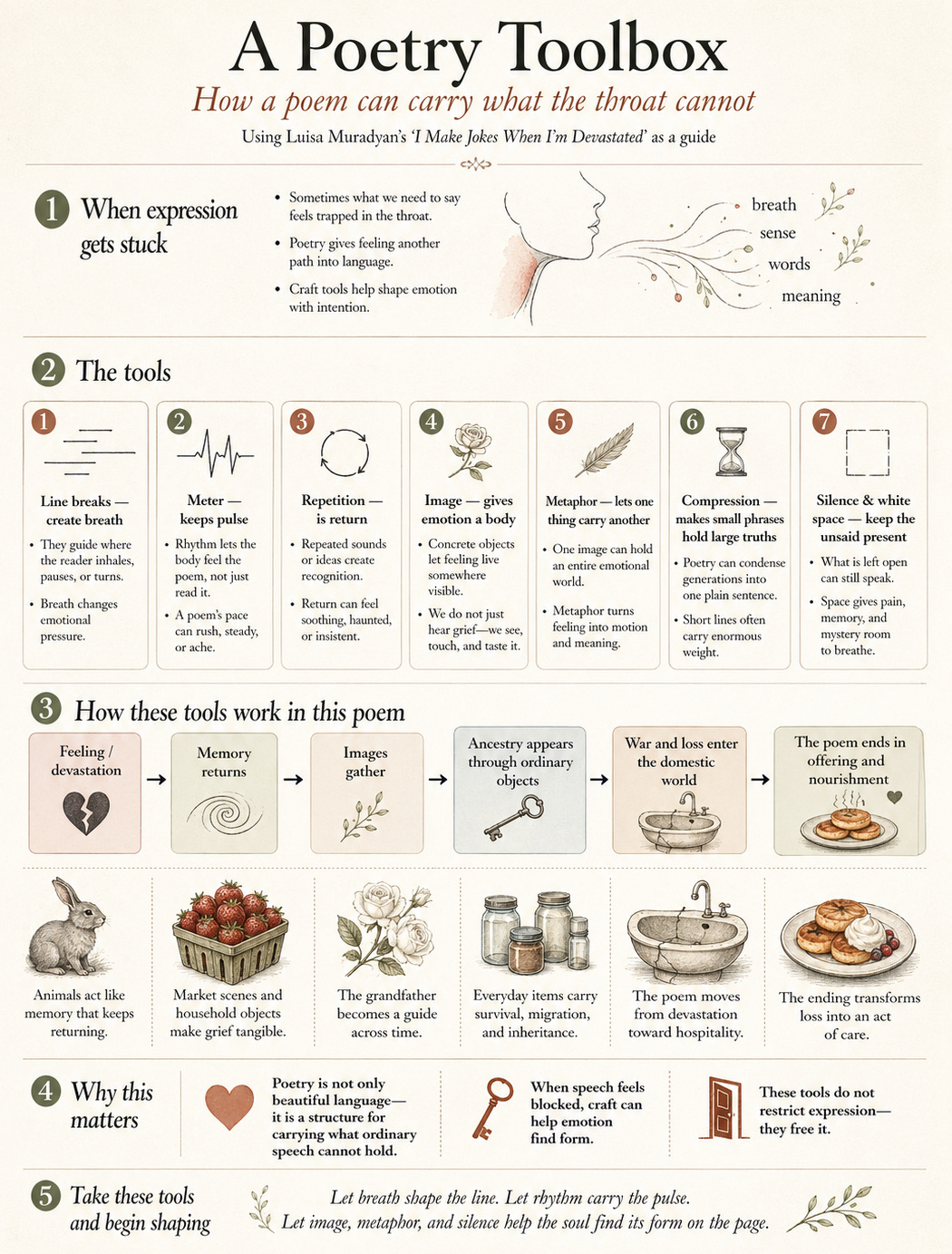
Now let’s look at how these tools work inside the poem itself.
Reading the Poem Through the Toolbox
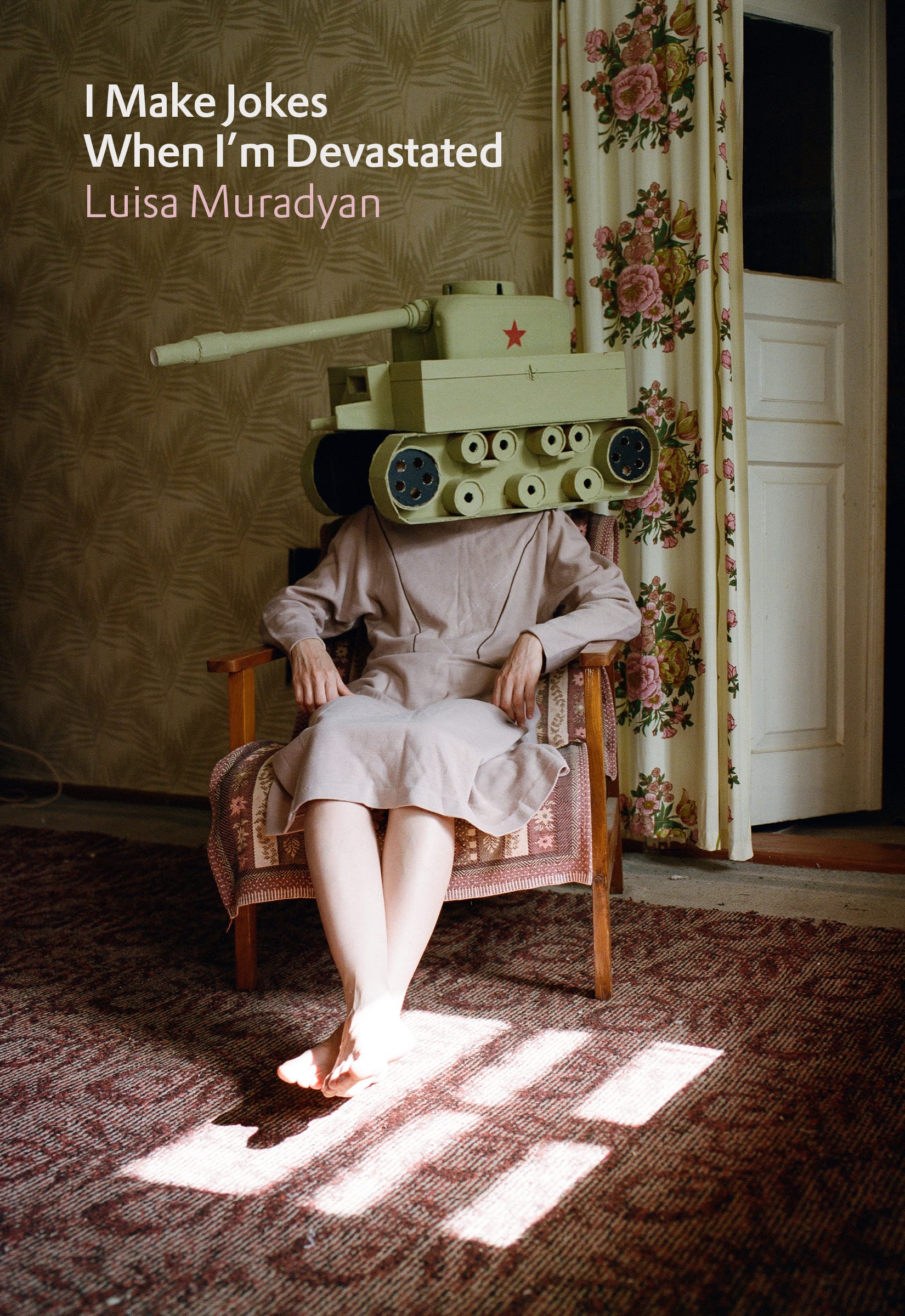
I Make Jokes When I’m Devastated
By Luisa Muradyan

"Into Oblivion"

Someone has accidentally set the forest on fire
and having clocked in for the day I turn
this catastrophe into a little poem.
Some days writing feels like this
an animal presents itself to you
and asks to be remembered
maybe the rabbit chewing dandelions in your yard
or the bat gliding over your head in the auditorium.
As much as you may want to move on, the animals
will follow. Today is a quiet day and I am stuck
checking inventory. The things I don’t want to remember
I shove in drawers that no one will open,
memories where I was harmed,
no, memories where I was loved.
At the market in Odesa
my grandfather waits for me.
It is my turn to haggle over
the price of strawberries,
once again I am too American
for this moment, he wants me to
do what I have been taught to do
he wants me to survive. He is of course
dead, leading me through this life
by hiding images throughout the world,
used paper towels that I have learned to
fold and store beneath the sink, half-rotten tea
bags that I will return to the soil, and pickle
jars that now hold soup and rainwater.
Back at the market, I follow my grandfather
through the meat section and stop
at the butchered animals
be specific he tells me
and I return to my desk
to write about the concrete apartment
building where my grandfather
watered white roses on our balcony
in Odesa, where bombs now fly
into buildings, into this building
into the cracked sink
and pictures of dead
relatives and the rug nailed
to the wall that my father
smuggled on a train
from Czechoslovakia
and the books, and the old
domino set with the carving
of the naked woman on the
cover, tits out and bush on fire
and oh the crystal shot glasses
those only remnants from my grandfather’s
wedding, the day he married a woman
who made the best syrniki in the world.
Here,

sit down and eat.
1. Catastrophe becomes a poem
This poem opens with a forest fire, then turns that catastrophe into “a little poem.” That movement matters. The fire becomes a metaphor for devastation, but the poem itself becomes an act of shaping. It shows us that poetry can begin inside catastrophe, not after it’s been resolved.
Toolbox: metaphor, compression, tone.
Note: begin with one image that carries the emotional weather.
2. Memory arrives as animals
The poem then gives memory a body. A rabbit and a bat appear not as decorative details, but as living presences that ask to be remembered. The animals follow because memory follows.
Toolbox: image, repetition, return.
Note: when a feeling is too big to name directly, introduce it through something visible.
3. The poem corrects itself
When the speaker says she shoves certain memories away, the poem turns from harm toward love. That correction is powerful because it shows thought happening on the page. Love can be as difficult to remember as pain when what we loved is no longer fully reachable.
Toolbox: syntax, revision, compression.
Note: let the poem change its mind. Sometimes the correction is where the truth enters.
4. Inheritance lives in ordinary objects
The grandfather appears through the market, strawberries, paper towels, tea bags, and pickle jars. These objects carry survival, migration, tenderness, thrift, and family instruction. The poem reminds us that ancestry often lives in what people save, reuse, cook, carry, and teach.
Toolbox: image, metaphor, rhythm, specificity.
Note: don’t overlook ordinary objects. They may be holding the whole story.
5. “Be specific”
The grandfather’s instruction becomes a craft lesson for the poem itself. Be specific. The poem doesn’t stay vague. It gives us butchered animals, white roses, a cracked sink, a rug, books, shot glasses, and food. Specificity makes feeling tangible.
Toolbox: image, voice, detail.
Note: when the poem feels distant, ask what exact object, room, taste, or gesture belongs there.
6. War enters the domestic world
The poem moves from the balcony and white roses into bombs, buildings, a cracked sink, family pictures, and a rug smuggled across borders. War isn’t treated as an abstraction. It enters the home. It enters the objects people touched and the places where they lived.
Toolbox: juxtaposition, pacing, image.
Note: large histories become more powerful when they are shown through intimate spaces.
7. The poem ends in offering
After devastation, memory, war, displacement, and death, the poem ends with food. This final gesture matters. Grief becomes hospitality. Memory becomes nourishment. The dead continue to feed the living through voice, recipe, and care.
The break before the ending creates a pause, almost like a threshold. The poem stops explaining and lets the ancestral voice enter. This is great use of white space. This is also the first poem of the book, which in effect invites us to “sit down and eat” as if it’s welcoming us into the book itself.
Toolbox: compression, silence, image, return.
Note: an ending does not have to solve everything. Sometimes it only has to offer the truest gesture.
What This Poem Teaches Us
Luisa Muradyan’s poem shows that poetry isn’t only about expressing emotion. It’s about shaping emotion so it can be carried.
Line breaks create breath.
Rhythm gives the poem a pulse.
Repetition shows how memory returns.
Image gives emotion a body.
Metaphor lets one thing carry another.
Compression allows a small phrase to hold a large truth.
Specificity makes grief tangible.
Silence and white space keep the unsaid present.
This is why poetry can be so freeing for those of us who sometimes feel that language is trapped in the throat. We don’t have to begin by explaining everything. We can begin with one image, sound, line, object, or gesture. We can begin with one thing remembered. Then we shape it.
We give it breath, rhythm, form, and somewhere to live outside the body. And sometimes, once it’s on the page, what was trapped in the throat can finally begin to speak.
Bridwell Press / Project Poëtica
Luisa Muradyan’s “Into Oblivion” appears in I Make Jokes When I’m Devastated, published by Bridwell Press / Project Poëtica.
You can learn more about Bridwell Press and read free PDFs of the books here:
https://www.fulcrum.org/bridwell
*As an added bonus, an excerpt from Rebecca Gayle Howell’s new book-length poem, Erase Genesis is available as a sneak preview on Oxford American’s website now! The full book will be available as a free PDF and to purchase as a hardcopy on April 28th on Amazon and Fulcrum, while supplies last.
Bridwell Press follows an open access model, which means readers can view and download PDFs online for free. Hard copies are also available for purchase at minimal cost.